I am a linguist who loves literature and who is fascinated by science. I quantify randomness. I paint. I travel in a power wheelchair, hoping to capture the ordinary.


Showing posts with label disability. Show all posts

Sunday, January 20, 2013

Silence and hope


It would seem as [...] though we are surrounded by myriads of emaciated words. They limp about, wounded by their lack of silence, and wounding others as far as they go. Words that only come from other words are lonely,  but  also  hard  and  aggressive.  Words  not  coming  from  silence  are  automatic,  obstinate,  and desperate – and could be called orphans.  “The tongue we speak today is no longer a mother-tongue but rather an orphaned tongue.” (Picard 1948: 41) Indeed, we are surrounded by sounds severed from silence, as opposed to sounds saturated with silence. (Cilliers, 2008)

Recently I made the decision to leave social networking sites. I found that I was offering my energy to a void, where the limits to true human connection were simply too much. Sherry Turkle, in her NYT article "Flight from Conversation," made a strong argument for face-to-face connection, for being present in the silences--silences that cannot be transmitted or lived on media such as Facebook: "Most of all, we need to remember — in between texts and e-mails and Facebook posts — to listen to one another, even to the boring bits, because it is often in unedited moments, moments in which we hesitate and stutter and go silent, that we reveal ourselves to one another."

I have decided, as my Tricycle newsletter this morning advised, to attempt to abandon futile endeavors. It seems to me that part of the attraction of social networks is that they can offer some sort of tangible evidence that others find us worthy (at least enough to "friend" us and maybe click on something we posted).


As somebody with a body that is perceived as so vastly different from others', I have spent much of my lifetime trying to prove my worth, trying to convince others who could not relate to me that I really was just like them, trying to help them see me, accept me, find a way to surmount the insurmountable beliefs about value and body, find true friendship in my company.
Harlequin woman

I am certainly not alone in this. Disabled blogger Carly Findlay writes, "Maybe I'm doing a metaphorical forward roll every day. To prove that I can do. To prove that I'm more than how I look. And to break down the assumptions people make about me and others with chronic illnesses and disabilities."

How much energy am I willing to spend to make myself human enough in another's eyes? Could this ever really lead to a mutually fulfilling relationship? It is a futile endeavor. I am not advising giving up hope. But what is of little value is not worth our time.

I seek the rare treasure, the silent understanding. I will do no song and dance. Connection is scarce, but that is okay. It is worth the effort, worth the wait.

What is scarce is not lost. Sometimes even the smallest spark of hope may be enough for the spirit. The whooping cranes are a lesson in placing one's heart in what matters. They are slowly recovering from the edge of extinction, with a population that has risen from a mere 15 birds to 600 with the help of Operation Migration and other groups. (If you are interested and able, you can contribute to the cause.)

 
Video streaming by Ustream

In human interaction, for me, the quiet spaces are my whooping crane. In these moments, there is a deep knowing and a presence. There is no question of worthiness, no painted mask, no juggling of truths and lies. I tend to this silence.

Professor of Theology at Stellenbosch University J. H. Cillers has written of the spiritual value of silence in our lives in his article, "Silence is Golden: Liturgy beyond the Edge of Language." I quote him here at some length:
Silence could of course be understood in many ways [...]. It may mean different things to different people. We know that there are different kinds of silence. The silence of sitting on the porch and watching as the setting sun winks her last light at you. The indescribable silence when moving from the house in which you stayed for thirty years, and you walk through the empty rooms for a last time, and the walls whisper the sum total of experiences that you had in this space and you know, deeper than words can express: there is a time to come, and a time to go. Or the strange silence that you experience in a graveyard, when the cooing of the doves in the trees deepens the silence and you know: our years pass by like a fleeting thought...

Willard differentiates between solitude - “being out of human contact, being alone, and being so for lengthy periods of time”- and silence (1998: 357). He concludes: “Silence means to escape from sounds, noises, other than the gentle ones of nature. But it also means not talking, and the effects of not talking on our soul are different from those of simple quietness.” (1998: 357)

Although silence is part and parcel of our genetical make-up (cf. further on), it is apparently also something that needs to be learned, a lost art that must be retrieved. The fact of the matter is that we normally react on an “epidermal” (skin-deep) level, automatically, following the usual stimuli of life. But in and through silence we escape the patterns of epidermal responses, with their consequences. This is however something that we find particularly hard to do. For us, the very idea of doing nothing could be absolutely terrifying – especially in our achievement-driven society. Indeed, it seems as if one of the greatest of spiritual attainments of humanity could be the capacity to do nothing. Because we do so much, we have so little of real value.
Togetherness in silence, a gaze, a touch, a shared view of the warm light hitting the trees--these alone tell me that we, imperfect and strange beings that we are, are more than enough.

A couple embrace in a park with snowy trees seen around, with the air temperature at about minus 8 degrees Celsius (17.6 degrees Fahrenheit), in Russia's southern city of Stavropol, on December 24, 2012. (Reuters/Eduard Korniyenko).
Cilliers, J. H. 2008. Silence is Golden: Liturgy beyond the Edge of Language. Paper delivered at the annual meeting of the Society for Practical Theology in South Africa, 14-16 January 2008, UNISA, Pretoria.
Picard, M. 1948. The world of silence. London: The Harvill Press. 
Willard, D 1998. The divine conspiracy. Rediscovering our hidden life in God. Harper: San Francisco.

Thursday, September 6, 2012

Sheltering the Wild

"To love is to approach each other center to center." ~ Pierre de Teilhard de Chardin

It has taken me a long time to write this post, perhaps because it touches on the "heart" of things. I want to write about unconditional love, about revelations that allow the connection between two beings to ignite with wild lightning. This is about holding on in the storm, not because we are kind enough to pretend it is not that bad or we don't really feel the lash of the wind in someone else's pain.

Francoise Gilot (French, b.1921), Little Girl with Owl 1960
It is about joining in the roll of thunder, pairing each other's scars like kindling for a warmth we seek, because the wild heart in each of us deserves to be gazed upon with full acceptance. In my most honest love, there is a place for the safe unveiling of brutality.

“To love another another human in all of her splendor and imperfect perfection, it is a magnificent task...tremendous and foolish and human.” ~ Louise Erdrich, The Last Report On The Miracles At Little No Horse

Our centers are full of divinity and light, yes. But there is also pain and fear, rage and hunger. To deny this in ourselves is to feel ashamed of our very natures. To deny this in others, or to judge it as diminishing the other, is to offer a cowardly love. We cannot fully love without the revelation of imperfections. So when we hide our ugliness, we are, in effect, refusing the chance to be known and loved.


Such a shrinking away from wholeness, and its concomitant lack of trust, has dire consequences in all aspects of life, not just in our most intimate relationships (as if this alone were not bad enough). John Warner recently wrote a self-proclaimed "preachy" piece on truth in Inside Higher Ed, entitled "A Column Not to Be Dictated to by Fact Checkers," in which he discussed this phenomenon in today's classrooms (and politics). I found the following excerpt particularly relevant:

Found here
"I sometimes read about how the current generation has been ruined by the self-esteem movement, but they can hardly be blamed with their role models, champions who cheat, politicians who lie, journalists who don't believe there is such a thing as truth.

Or a teacher who is worried about looking like a square when he says he believes in truth. All of us are signaling that there’s nothing much worthy of belief aside from our own “success,” our image, and how we’re perceived on some imaginary scoreboard.

These are all forms of cowardice, a lack of trust in ourselves and others, that we will not be judged of value unless we are perfect, if we are anything short of outstanding."

This is not to say that we should parade our scars in some sort of victim dance. But to cover ourselves in "goodness" is a kind of death: “To banish imperfection is to destroy expression, to check exertion, to paralyze vitality” (John Ruskin, The Stones of Venice).

In some way, I approach this topic as a sociolinguist. I know that in language, like in all human systems, attainment of a "perfect" state cannot be achieved except through death (and yes, here, I am mindful of the spiritual implications of this). And even then, what is considered the "perfect" moment is debatable, not to mention a mere abstraction. In language, it is the variation, its very state of imperfection, of dynamic motion and persistent change in a world that never experiences the same moment twice, that allows it to flourish. Languages do not survive despite their imperfections, but rather because of their imperfections. I think this sheds a new light on our lives.

by minimaforms, 2008. “Minimaforms was invited by
Archigram’s David Greene to rethink and evolve his
seminal projects the Living Pod and High-Rise Tower
as part of a show called Imperfect works.” Exhibited at
Mega-Structures Reloaded, Berlin (2008) / Imperfect Works,
London (2008).
"The key to a rational conception of language change – indeed, of language itself – is the possibility of describing orderly differentiation in a language serving a community … It is absence of structural heterogeneity that would be dysfunctional." (Weinreich et al. 1968: 100–101)

A language that does not shift, bending rules and opening itself to "strange" new patterns, is soon a dead language.

On the spiritual question, Lacey Mosley discovered that she could see God's grace best through the lens of imperfection: “I've learned recently to love imperfection a lot because it shines such a big light on God's grace. And if someone has grace for you that's when you feel their love the most and they see you for who you are and they love you anyway.”

When I compare our "imperfection" to the "imperfection" of human systems like language and culture, it dawns on me that there is nothing to be forgiven. It is not that we must love "anyway," but that through this, we love. Through this wildheartedness that is our life force, we understand:

Louise Butler, Journey to Nimbus (2010), oil on canvas
“But those who seek only reassurance from life will never be more than tourists—seeing everything and trying to possess what can only be felt. Beauty is the shadow of imperfection.” ~ Simon Van Booy, Everything Beautiful Began After

So yes, we must shelter our wild (heart/tongue), but not because it is shameful. If we shelter it, it should be to save it for those who will know how to feed it. What a mess Einstein once was! But he did not shrivel away. And, I would argue, it was this very messiness that brought him to question everything, and to change our understanding of the world. I assure you, he is not the only example.

“You are a child of God. Your playing small does not serve the world. There is nothing enlightened about shrinking.” ~ Marianne Williamson

In disability, our mess is also our greatness. This is not because we are meant as inspirations to others, as some sort of epiphany-producing humanoid object. This is because the mess of disability itself is a question, which is a curiosity, which is a quest, which is a revelation. Love the imperfections, crawl into them and gaze from the inside out, and a rich new world will unfold.

Weinreich, U., Labov, W., & Herzog, M. 1968. "Empirical foundations for a theory of language change." In: W. Lehmann & Y. Malkiel, eds., Directions for historical linguistics. Austin: University of Texas Press. 95-198.

Thursday, July 19, 2012

Slow time

We must begin to think differently, perhaps: We have all the time in the worldOf course, this is a lie, and we know it. But pushing the egg out of the nest accomplishes little good.

Lottie and Minnie, from elevisions
A lesson delivered in tumbled syllables is not learned. Hurried intimacy is not intimate. Forced conversation does not build the relationship so desired. In the rush for bliss, bliss is lost. This is about restraint and purpose. In our work, it may be about making intellectual connections and diving into the depths of the springs with measured breaths. In our bodies, it may mean long walks and all-natural ingredients. (See, for example, the Slow Food movement.) In our relationships, it may be about listening and tenderness.

John Huckins, a blogger at God's Politics, contemplates the role of "wasting" time in Jesus's life:

As I walked the modern-day ruins of this site, I couldn't help picturing a 20-year-old Jesus working next to his dad while listening and living a radically submerged life within this context. While shaping rock that would act as foundations for buildings whose use he may or may not have agreed with, Jesus was present.

Jesus was not just present for a year or two; he was present for 30 years before entering his formal ministry.There is an element of lingering inherent with submerging. It is a willingness to be present to the point of feeling like we are wasting time, when in reality we are leaving ourselves open to be used by the Spirit in ways we be might otherwise have never been aware of. Lingering is not simply walking aimlessly in circles; it is knowing what we are looking for and being intentional with our time and presence.


Sigur Rós - Glósóli from Arni & Kinski on Vimeo.

In The Creativity Post, Michael Michalko notes that famed surrealist Salvador Dalí, in his search for the artistic visions that populated his works, had a certain technique. He wasted time, drifting in and out of sleep:

His favorite technique is that he would put a tin plate on the floor and then sit by a chair beside it, holding a spoon over the plate. He would then totally relax his body; sometimes he would begin to fall asleep. The moment that he began to doze the spoon would slip from his fingers and clang on the plate, immediately waking him to capture the surreal images. (more here)

How many spoons? How many hours? And yet, do we fault him for this? Should he have been out working harder, painting more, without spoons or tin plates? What kind of artist would he have been? Would our vision of the world have been the same without it?


Two of my favorite children's books talk about the value of giving your heart to the squandered moment: the wandered road or the accidental friendship. In Grasshopper on the Road (1978), an open-minded grasshopper on a walk encounters all sorts of characters: beetles who have political tunnel vision and only love mornings, a worm who is fastidious about his belongings, butterflies who cling to routine, a fly who cannot stop sweeping.

Cat's makeshift home
All of them live in the trance of daily life, without contemplation, filling their days in ways that will never be enough, never make them full. Ah, but the grasshopper, he alone seems happy.

The second book, J.T. by Jane Wagner, is about a young man who is struggling with bullies and with his own sense of morality discovers a half-dead cat. He builds it a makeshift house, feeds it, and visits it every day.Through patience and love for something that has been left to struggle on its own, obviously seen as a "waste of time" to all who had passed by the wretched (beautiful) creature, J.T.'s spirit is transformed. The photographs are by Gordon Parks, Jr. (more here on this and its relevance to black history and film, with spoilers). The book is from a movie, the first part of which I've posted here. I warn you, it is a very, very sad story. But it teaches us something about slow love.


I must admit here that my advocacy of slow living does include some self-interest. It is only with such a mindset that those of us with disabilities become truly equal. It is in the loss of preoccupation with routine and norms that we find space for the diverse physiology and neurology of the human species. Too often, those of us who have disabilities are discarded: our gaze is not met, our words are not heard, our love is not reciprocated. This is not a consequence of the disability itself, but of the social forces that tell us to avoid "wasting" time, that push us to reach our goals as quickly as possible. Indeed, if you spend time with me, things will go more slowly. I might "waste" your time. And the same might be said for the soft-spoken, the tangential thinkers, and those from distant lands. Do we really not have time to lift somebody's weak body out of a car, to wait for well-thought-out words to emerge from hesitant lips, to follow a roundabout path of cognitive connections, or to bear some of the communicative burden of a tongue that carries what we perceive as an accent? What exactly are we here to do?

A focus on the process draws our attention to a space of loving presence.

I admire gleaners, those who pick up odd things from the road because they are interesting, these things others have discarded, forgotten, or simply walked by, unnoticing. I value this because it means they can see as others cannot. It means that, in their eyes, I, too, might be good enough to keep.

French filmmaker Agnès Varda is a visionary, I believe. In the spirit of gleaning, I leave you with her full-length documentary on the idea, both in the history of French art and as a practice of survival in France today.


Les Glaneurs et la Glaneuse from WDROTV on Vimeo.

Tuesday, May 22, 2012

"Soft, yes. Weak, no."


In her well-known article on the traits of gifted adults, "Can you hear the flowers sing?", Lovecky writes of the trait of sensitivity:

Zhaan from Farscape
Zhaan from Farscape
"A depth of feeling that results in a sense of identification with others characterizes the trait of sensitivity. Gifted people form deep attachments and react to the feeling tone of situations; they think with their feelings. People who are highly sensitive make commitments to other people and to social causes. They can be enthusiastic and intensely single-minded about their dedication. Poets, Investigative reporters, Peace Corps workers, and political and religious leaders are often gifted in sensitivity. Examples of such people include St. Francis of Assisi, Elizabeth Blackwell, Emily Dickinson, Ghandi, Martin Luther King, and Virginia Woolf.


"People gifted with the trait of sensitivity find positive social and emotional benefit in their deep concern for the needs and rights of others, their empathy for the feelings of others, and their desire to help even at significant cost to themselves. These gifted adults may be unusually aware of the feeling tone of situations and of the more sensual aspects of the environment, such as color and shading. They are often aware of their own shortcomings. Some gifted adults feel a sense of unity with the cosmos, an experience of a universal sharing of self. Adults gifted with sensitivity tend to be highly moral people concerned with giving and with doing what is right for others."

rainforestUnfortunately, any sensitivity has the tendency to be viewed as somehow passive, fragile, or weak. Yet let us think in other terms for a moment. Psychologist (and my former teacher) Paula Prober refers to such minds as "rainforest minds": rich, vibrant, and, yes, sensitive. In the density of its riches, apparently small damages can create disproportionate harm. The plants heal, the animals are beyond compare.

So sensitive folks are simply densely rich. Does this come with a certain vulnerability? Yes. Does it mean weakness? No.

To turn to another world now, we may remember Toph from Avatar: The Last Airbender. She is small, female, and blind. Her hyper-sensitive feet "see" for her; they remain exposed to the world, easy to damage, far from impervious to the lash of any flame. Yet it is this that makes her powerful.


We must learn to move in new ways.

Sunday, September 26, 2010

Subject and object confusion

The film The Plague Dogs is a heartbreaking tale of life as an escaped lab animal, replete with friendship, violence, and a rare lack of pity for the viewers. It is based on the novel by Richard Adams, who also wrote Watership Down. One of the lab dogs has undergone an experiment in which the subjective and the objective have been confused in his mind: flies in his head are helicopters in the air. He cannot tell which parts of the world he actually exists in, nor can he make sense of how his actions change his situation or hope for love and survival.


Sometimes the institution-trapped mindset of the disability services industry throws human subjects into similar throes of nobodiness. I was dealing with a broken wheelchair, my beautiful customized Quantum R-4000, earlier this week. I called to get it repaired, and requested a standard chair like those in the commercials on TV, just so I could, you know, sit at the dinner table, shower, and go to work and stuff.

I was rotundly denied, informed that I was simply too disabled to sit in a regular power chair, even though my insurance would cover it. I should plan instead to live out a few weeks wrapped up in blankets in bed or on the floor. No dinner table, no bath, no job.

This was even after a phone call from my doctor. Trapped by my computer for two days, I persisted with Skype calls. Finally, they requested a letter from my doctor. Got it. Not enough. They wanted a letter from my "caregiver". No mind that my caregiver is hired, trained and fired by me and has no relation or real relationship with me. No mind that I am, in fact, my only legal guardian. They insisted that there must be somebody in charge of me. No, I explained, only me, and you are about to ruin my life and risk my death. Here's a signed letter saying just how you are destroying me... Signed, the Professor. OK, finally, I was human enough to have my own words effect change. I am no one's object.

Sunday, January 10, 2010

Undesirable

My maternal grandmother's family came to New York from Poland before WWII, an orthodox Jewish family who found a new home just before it was too late. One cousin, however, cousin Benjamin, was not allowed entry into the United States. Benjamin had a hunched back, and used a cane to walk. When I was little, I saw a picture of him in my grandmother's old photo album. Yes! Someone like me. I was excited to see that I was not the first in our family to have a different kind of body. He was wearing a suit and tie, a young lad with a dark beard. I asked what happened to him. I was told that he died young. Was he sick? Yes, they said, he was sick.


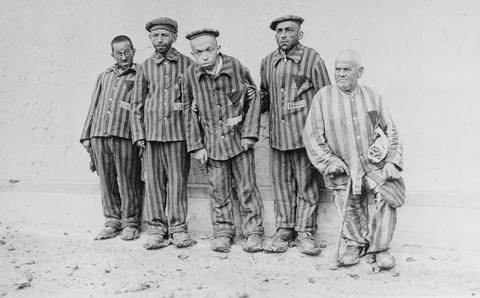
A decade later, "old enough" to handle the truth, I was informed that Cousin Benjamin had been murdered by Nazis during the Holocaust. Unacceptable as an American citizen, he was returned to Hilter. The disabled were among the first to be killed, as the most obviously undesirable kind of human (image found at A Teacher's Guide to the Holocaust). I was appalled that my own country (surely in its intellectual and moral infancy) had made such a mistake. Yet it appears that this same practice continues today in Canada.


While Benjamin's story will always stand out in my mind, denial of the human right of mobility through migration (especially but not only to escape violence) is only one of many ways disabled folks are "dumped." William J. Peace writes:


"Wheelchair dumping is the antithesis of inclusion. Disability rights activists coined the term inclusion over the well-known concept mainstreaming. For nearly two decades disabled people have fought to be included, their existence valued. This effort has met stiff resistance -- especially in the court and educational system. Disability rights activists have fought for inclusion because it reflects the idea that all members of society are equal and capable. In theory this idea is accepted but rarely if ever put into practice. It's easier and cheaper to ignore the rights of disabled people and "dump" all those who don't fit in. In the past we had institutions to dump people into -- most of which were closed in the 1980s, thanks to Ronald Reagan. In their place we have a host of inaccessible facilities, like my local police station, or other government facilities, many of which contain "resource rooms". The vast majority of these rooms accomplish what institutions once did -- segregate those that are not wanted. It is easier for institutions such as public schools to "dump" all children with learning disabilities into a "resource room" than include them in classrooms with other children. If the parent or child balks, they can deem the child disruptive and the district can literally force the child out of the district and into "special programs". It is up to the parent to hire experts and prove their child is not a disruption to other students. To me, this is the legacy that Reagan should be known for because he took dumping to an extreme -- especially for those with mental illnesses who were dumped on urban street corners across the country." (from "The Outrage is Misplaced: Wheelchair Dumping", 2008) 

We also have the questions of abortion, which I was lucky enough to escape because technology did not detect the shape of my body in utero, institutionalization, which was recommended for me on the day I was born (also narrowly escaped), and sterilization (which was unsuccessfully pushed upon me at the age of 12 in 1990). Just as Cousin Benjamin was worth more dead (valued at zero) than alive (negative value), I was reminded of my "selfishness" in keeping organs that I should never use. Never mind my love for writing, my talent with languages, my artwork; none of this could make up for the undesirability of my body, a reproductive catastrophe. Now a linguistics professor, I am reminded yet again that my mind is not enough to make me human: I should not think to try to build a life in another country. These phenomena are not of a distant past at all.


Saturday, January 9, 2010

The ephemeral and empathy

Les gens ne disent pas des textes. Ce ne sont pas des textes. Ils parlent, tout simplement. Et vite ils oublient ce qu’ils ont dit, qui d’ailleurs ne compte pas : ils n’ont parlé que pour parler ; leurs paroles ne sont que prétextes pour parler nous-même, c’est ainsi depuis que va le monde et ce sera ainsi jusqu’à sa fin. ("Il se souvint du minium", Bernard Deglet)

I am tempted most of the time to believe this, that we are disconnected self-centered insecure beings whom mortality dooms to be pointless and whose very nature of self-as-center allows our one possible contribution beyond this life to slip into the ephemeral. Your words are just an intonation unit of waiting, and at the first hint of a chance to take my turn I will hit the floor running. Conversation as masturbation, not as intercourse. We seek out company merely for self-mirroring validation?

But no! There is something precious and painful about being near others. We are something bigger, and our empathy, ephemeral, contributes somehow. Floats out between us, within us. I have to believe that. There is evidence presented in the posthumous work of Teresa Brennan, The Transmission of Affect, that we are not self-contained in the ways that we tend to believe.

Chally, at her blog Zero at the Bone, comments that, with disability, "I no longer trust that people will stick by me when things get inconvenient, when being my friend gets messy; that I’ll get the support I need." True. But I've been lucky. There are those few who stick around through the mess and still look me in the eyes. So few, these folks, that my gratitude may seem in unfortunate disproportion to the facts. Wipe my ass for free, speak to me in soft languages, and allow me to offer some reciprocation, some comfort in return, when your life gets messy. And there I am, bursting with all of my Leo loyalty.

At the memorial service I attended yesterday, one of these few in my life was among the principal mourners. Front and center. Those who usually see only sourness in her walked single file to greet her, touch her hair, hold her in circumstantially loving embrace. I sat midway back, parked in my wheelchair, the space small and cumbersome. She came back to greet me, touched my fingertips because I moved my arm to reach for her. Gratitude and sorrow a heavy pearl in my heart. My frustration was paramount. I could not wrap my arms around her. So I locked onto her gaze. Not just waiting for my turn to start. Just waiting. Dr. Brennan believed that empathetic reactions were just as real (and reliable?) as chemical reactions: "The origin of transmitted affects is social in that these affects do not only arise within a particular person but also come from without. They come via an interaction with other people and an environment. But they have a physiological impact" (Brennan 2004:3). I hope she was right. That we can touch without touching.

Tuesday, January 5, 2010

Death and affect in the sub-tropics


One difficult thing about living in Florida--over three years now--is my sensation that the roots are missing. Instead, I find myself in a pulsating jungle, where the life and death smell hot and shocking for a Northwestern sapling gone astray. (image, right, from "History & Images of North Florida", Images, D. Penney, 2003") Lizards scurry in front of shuffling feet; armadillos lie, furry bellies exposed, shells cracked and bleeding; irises pop up out of sidewalk cracks; moss hangs orange in the setting sun. Grasshoppers as big as my hand. Owls, hawks and vultures. Spiders. Waiting for the inevitable. Nothing lasting long enough to resist the next hurricane. Uprooted, start again.

The relationships to people, too, here, feel that way. Only after these three years, do I feel roots entangled in mine, have I made connections that do not feel haphazard. (Am I talking about the fibers in Avatar? Maybe.) Yet affect has sprouted from the sandiest regions of my heart; I have better things to do than grow roots in this little landing strip! Even when we know it is all temporary, we can't help ourselves from clinging to the nearest solid bit around.

This week, my friend's young step-daughter died, circumstances unclear. Alone. Death in Florida, and one of my solid bits is crumbling beside me/within me. I hold on by growing deeper roots around the one left living. Holding off the inevitable.

Another recent death, much more distant in terms of relationships but much closer in terms of personal identification, was that of the singer-songwriter Vic Chesnutt. This week, his tune "Florida" feels particularly apt:


Suicide is not for me right now. The balance of affect and intolerability still weighs in on the side of staying around to see what happens, of not blowing away too soon, uprooting lives attached to mine.

Thursday, December 31, 2009

Little pleasures (and pain)


Tony Judt is a professor, historian, author. He also can barely move. He writes:

"But one is also and always aware in this disease of the necessary normalcy of other people's lives: their need for exercise, entertainment, and sleep. And so my nights superficially resemble those of other people. I prepare for bed; I go to bed; I get up (or, rather, am got up). But the bit between is, like the disease itself, incommunicable." (More here: Night - The New York Review of Books.)

When you can't move, small gestures explode into deep meaning, annoyingly tinged with theatrical melodrama. How long has it been since I have touched another person's face with my fingers? If I were to do so, would I not be overwhelmed with emotion? When daily life (dressing, showering, getting fed) feels like an assembly line job, when I have an early curfew and never a day off from this routine, that small dose of "fun" (a university course in literature, a coffee with a friend) is monumental. It helps me to feel human. The normalcy--"exercise, entertainment, and sleep"--I will go to great lengths to taste it for a moment. It is an I-would-rather-die-than-lose-this kind of thing. And I will fight you to the death for these crumbs.

I am reminded of Samuel Beckett's "Krapp's last tape," how we cling to those few moments of beauty.


Download:
FLVMP43GP