I am a linguist who loves literature and who is fascinated by science. I quantify randomness. I paint. I travel in a power wheelchair, hoping to capture the ordinary.


Showing posts with label poetry. Show all posts

Monday, January 28, 2013

Homing

Hestia, Greek goddess of home and hearth

To Hestia
by Hesiod

Hestia, you who tend the holy house of the lord Apollo,
the Far-shooter at goodly Pytho,
with soft oil dripping ever from your locks, come now into this house,
come, having one mind with Zeus the all-wise
draw near, and withal bestow grace upon my song.


This weekend I watched The House (spoilers ahead), a Korean animated film in which old, traditional homes are guarded by and are one with spirits who must face their imminent deaths as new, modern condos replace old, dilapidated buildings that are full of  mold and cracks. (See photographs documenting this process here, along with some unfortunate sexist comments.) These building spirits harbor a certain affection and intimacy with home owners, so much so that a carefully kept home will respond kindly to the rhythms of its family. This is a sad story, so skip the next three paragraphs if you don't want to know.

The film makes a clear argument for valuing the soul over the bank account, and it offers a strong, if heavy-handed critique of classism in contemporary (Korean) society, the role of the government in exacerbating poverty and dependence, and the overvaluation of all that is modern. It is understood that the new buildings will have no spirits to guard them.

In "Modernization and contemporary culture in traditional Korea," Ito Abito explains:
Traditional Korean society manifested, as Takashi Akiba long ago pointed out, a rather sharp cleavage between the life-orientation of the upper-class yangban and that of ordinary commoners. The yangban, absolutizing Confucianism, looked down on or ignored folk religion, but the coexistence of the two strata was made possible by their division into two social ranks. The new life-orientation developed in the cities in connection with the rapid social change of recent years, however, has exercised a profound influence even on agricultural village society through the Semaeull movement and other media. Members of the rural elite, quick to respond to the modernization and industrialization policy of the central government, played a leading role in abolishing or discontinuing traditional belief and practice, some in token of symbolic support for modernization, others in token of loyalty to the Semaeull movement. This resulted, on the one hand, in the diffusion of the Semaeull movement throughout the country as a new spiritual movement and, on the other, in the rapid destruction of the basis for cultural identity that existed in the traditional culture.
In the film, as the houses are torn down, the spirits go with them, leaving only keepsakes: small trinkets in which their favorite memories are stored, visible only to those who hold the marble that connects the human and spirit worlds. In the end, this delicate glass ball is smashed by a government boot in the mud, and the spirits, in their dying moments, become invisible to our heartbroken protagonist, who had happened upon the marble in a brawl with a stray cat (who is, of course, the God of Land). She who once longed to live in a shiny new condo, is dragged silently away from the falling walls.


What struck me about this surprisingly—though accurately—pessimistic tale was its lovely portrayal of what it means to have a home. At one point, the girl and her house's spirit happen upon a homeless man in a box. The girl screams, taken aback by the man. The spirit looks and also screams, taken aback not by the man, but by the idea that a person should sleep somewhere where there was no house, no spirit to protect him.

Of course it went beyond the walls and ceiling: every little bit of the house, the old wallpaper, the worn floors, was infused with a sense of belonging, of safety. That, in my view, is why home matters so much. There are places that feel like that, and they are sacred. Buck claimed that "'home' in the full range and feeling of [Modern English] home is a conception that belongs distinctively to the word home and some of its Gmc. cognates and is not covered by any single word in most of the IE [Indo-European] languages" (Online Etymology Dictionary). In Spanish, the corresponding hogar has its roots in the Latin term for fire (compare modern Spanish fuego); indeed, the hearth was the old gathering place, the center of warmth and social life (Diccionario Etimológico).


We feel that way around certain people, too—at home, safe. In her article, "The orphans among us," Sarah Johnston contemplates what it meant to her to finally find a family, as an adult, when her own parents had never provided a safe place, a refuge:
It took a year and a half before I would see their daily call and not think, “Why are they calling?” I had no idea there were people who’d call you every day.
     Eventually I did. Eventually it became the most natural thing in the world. The Bible says that orphans are placed in families; and for a long time I believed in that and mistook having a family as the end, — the prize in and of itself.
     But what I have found — and what I pray the orphans among and inside us discover —is that being a part of a family, in time, stops erasing the pain of abandonment and starts being about the power of the future. It begins with an orphan and a family, but it ends with one trajectory being propelled into another.
The desire to be where we feel we belong is strong, and we are not alone among the species. Holly the cat recently became famous for her 190-mile journey on foot back to where she belonged.


Friday, January 4, 2013

Underwater breathing (when the trolls come)

Trolls in The Hobbit
Sometimes those who seem to love (or understand) only what is big and loud trample what they have never even noticed was there. Sometimes what they trample upon is the sensitive person's treasure, the tiny miracle the quiet visionary has been holding in her palm.
Carved Eggshells by Beth Ann Magnuson

She says in a whisper, too trusting, wanting so much to share the joy, "Look. Look at this little piece of me. It is the most beautiful thing I know to be mine." 

An excited troll lumbers over and smash--it is gone. He did not even know something could be that small, that intricate, or that holy. 

Her devastation is chalked up to childishness. "Bah!" says the troll. "I see nothing here! Why do you waste time?" 

When violence is caused by insensitivity, by a lack of perception of what one sees so clearly, who is to blame? How to cry foul?

In a gifted mind, where worlds are intricate and sensitive, this destruction can become the daily bread, simply a way of life:

One of the most common experiences of gifted children is a unique way of perceiving. They make more abstract connections, they synthesize diverse experiences, and they make sophisticated conclusions at an early age. Not that the gifted child's unique perceptions are always "true" to the rest of us, but they are powerful. The result is a child growing up with a reality somewhat different than the reality of her peers -- and often different from her parents, teachers, and allies.

Villa Epecuen, Argentina
Because they are different in other ways, gifted children are often isolated anyway. Somehow these multiple tendencies toward isolation reinforce one another to the point where the majority of gifted children feel lonely, left-out, or different.

This combination of unique perception and its concurrent isolation yield an emotional vacuum. After all, for most of us, our emotional selves develop by "bouncing off" of all those around us. (Joy and Loss: The Emotional Lives of Gifted Children, Joshua Freedman and Anabel Jensen, PhD)

As adults, we learn to live with it. Kind of. Despite the wreckage it will cause in our jobs and relationships, we go underground sometimes. It is sometimes at the bottom of the ocean, where sounds are muted and all is touch and flow, that we breathe best, and we remain unshattered.

Source
In The Noonday Demon: An Atlas of Depression, Andrew Solomon writes, "Mild depression is a gradual and sometimes permanent thing that undermines people the way rust weakens iron. [...] Like physical pain that becomes chronic, it is miserable not so much because it is intolerable in the moment as because it is intolerable to have known it in the moments gone and to look forward only to knowing it in the moments to come. The present tense of mild depression envisages no alleviation because it feels like knowledge" (p. 16).

It seems to me that this is more than a feeling of knowledge. Instead, it is often linked directly to knowledge. In a world of trolls, knowledge is a liability. How to extol the virtues of complexity to a boss who demands that you create something "fun"? How to present the ecstasy of subtlety to an audience seeking more "pizzazz"? To them, their way is obviously better.

So we hold our tongues, and sometimes our breath. And sometimes we dive down for air.


Don’t Tell Anyone
by Tony Hoagland

We had been married for six or seven years
when my wife, standing in the kitchen one afternoon, told me
that she screams underwater when she swims—

that, in fact, she has been screaming for years
into the blue chlorinated water of the community pool
where she does laps every other day.

Buttering her toast, not as if she had been
concealing anything,
not as if I should consider myself

personally the cause of her screaming,
nor as if we should perform an act of therapy
right that minute on the kitchen table,

—casually, she told me,
and I could see her turn her square face up
to take a gulp of oxygen,

then down again into the cold wet mask of the unconscious.
For all I know, maybe everyone is screaming
as they go through life, silently,

politely keeping the big secret
that it is not all fun
to be ripped by the crooked beak

of something called psychology,
to be dipped down
again and again into time;

that the truest, most intimate
pleasure you can sometimes find
is the wet kiss

of your own pain.
There goes Kath, at one PM, to swim her twenty-two laps
back and forth in the community pool;

—what discipline she has!
Twenty-two laps like twenty-two pages,
that will never be read by anyone.

Saturday, June 9, 2012

At home with the cats

Numbus II, 2012. Cloud in room. More here.
The rain is falling heavily today, with thunder and a dark heat that reminds me of other homes: Oregon in the fall, Puebla in late summer afternoons. It is exhilarating when the sky cracks open.

Rainbow against warm-gray sky; Eugene, Oregon.
© Greg Vaughn

At least, stuck in my house like this, I will not make my cats angry over abandonment.

This poem captures it so well, the sorrow of the feline (warning: this is sad; also, enlarge it if you can, to see the words):


And now to cheer you, a cat poem, found here:

The cat's song
By Marge Piercy

Mine, says the cat, putting out his paw of darkness.
My lover, my friend, my slave, my toy, says
the cat making on your chest his gesture of drawing
milk from his mother's forgotten breasts.

Let us walk in the woods, says the cat.
I'll teach you to read the tabloid of scents,
to fade into shadow, wait like a trap, to hunt.
Now I lay this plump warm mouse on your mat.

You feed me, I try to feed you, we are friends,
says the cat, although I am more equal than you.
Can you leap twenty times the height of your body?
Can you run up and down trees? Jump between roofs?

Let us rub our bodies together and talk of touch.
My emotions are pure as salt crystals and as hard.
My lusts glow like my eyes. I sing to you in the mornings
walking round and round your bed and into your face.

Come I will teach you to dance as naturally
as falling asleep and waking and stretching long, long.
I speak greed with my paws and fear with my whiskers.
Envy lashes my tail. Love speaks me entire, a word

of fur. I will teach you to be still as an egg
and to slip like the ghost of wind through the grass.

Marge Piercy, “The cat's song” from Mars & Her Children (New York: Alfred A. Knopf, 1992). First appeared in Matrix 28 (Spring 1989). Copyright © 1989, 1992 by Marge Piercy and Middlemarsh, Inc. Used by permission of the Wallace Literary Agency, Inc.

Source: Mars & Her Children (Alfred A. Knopf, 1992)


Sunday, September 26, 2010

Painting and flow

As an alternative to bouncing around the globe, especially when I am needed on the home front, I have taken up painting. Next month, two of my pieces will be shown in the Lines into Shapes show in Estes Park, Colorado. They chose "Reflection" and "I Shall Wear Purple," shown below.

Reflection

I Shall Wear Purple


The second image's title is taken from a collection of poetry by Jenny Joseph that I remember from when I was a child. This poem taught me the beauty and freedom of aging, of coming into one's own. The title poem goes like this:

Warning

When I am an old woman I shall wear purple
With a red hat which doesn't go, and doesn't suit me.
And I shall spend my pension on brandy and summer gloves
And satin sandals, and say we've no money for butter.
I shall sit down on the pavement when I'm tired
And gobble up samples in shops and press alarm bells
And run my stick along the public railings
And make up for the sobriety of my youth.
I shall go out in my slippers in the rain
And pick flowers in other people's gardens
And learn to spit.

You can wear terrible shirts and grow more fat
And eat three pounds of sausages at a go
Or only bread and pickle for a week
And hoard pens and pencils and beermats and things in boxes.

But now we must have clothes that keep us dry
And pay our rent and not swear in the street
And set a good example for the children.
We must have friends to dinner and read the papers.

But maybe I ought to practice a little now?
So people who know me are not too shocked and surprised
When suddenly I am old, and start to wear purple.


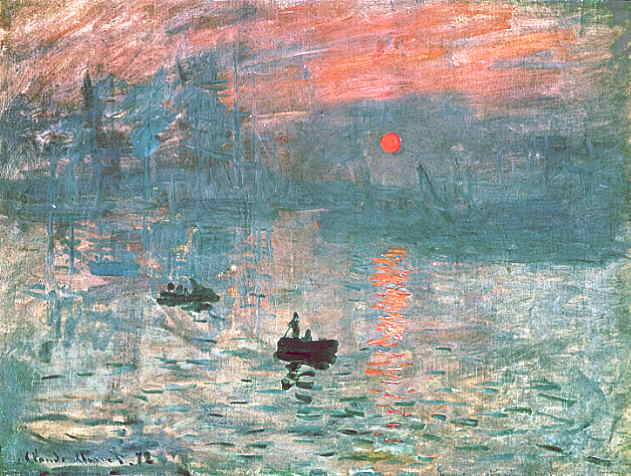
Speaking of art, if you happen to be passing through Paris (which I, unfortunately, am not), here's a chance to see works by the great Monet:


Impression: Soleil levant

Friday, January 15, 2010

Earthquake 
by Aimé Césaire


such great stretches of dreamscape
such lines of all too familiar lines
                                         staved in
caved in so the filthy wake resounds with the notion
of the pair of us? What of the pair of us?
Pretty much the tale of the family surviving disaster:
“In the ancient serpent stink of our blood we got clear
of the valley; the village loosed stone lions roaring at our heels.”
Sleep, troubled sleep, the troubled waking of the heart
yours on top of mine chipped dishes stacked in the pitching sink
of noontides.
What then of words? Grinding them together to summon up the void
as night insects grind their crazed wing cases?
Caught caught caught unequivocally caught
caught caught caught
                     head over heels into the abyss
                     for no good reason
except for the sudden faint steadfastness
of our own true names, our own amazing names
that had hitherto been consigned to a realm of forgetfulness
itself quite tumbledown.

(Translated, from the French, by Paul Muldoon.)


Thursday, January 14, 2010

Freedom, movement and pleasure


Feeling like a tree...
Originally uploaded by hajlana

Freedom means you are unobstructed in living your life as you choose. Anything less is a form of slavery. --Wayne Dyer

In the wake of the Haiti earthquake, it is hard to write about anything else. Upon seeing images of trapped bodies, dead and alive, on a small island, I can't help but think: they have no way out. So I'm thinking about movement as freedom, freedom as life, life as pleasure. Perhaps the last connection should not be made (it is generally naive). But for my purposes today, life as pleasure. (We'll leave Beckett out of this for now.)

In a recent article in French Studies, Ullrich Langer argues that the Renaissance poem offered pleasure because the poem was a landscape without constraints. All we ever want is to be able to sail away.


I am full of wanderlust, always. (I like something about the lady in this video; I find her rendition of this song touching. See lyrics.)


The trip is not always perfect, but the loneliness of human nature is less cruel when discoveries are being made.Joni Mitchell's entire album Hejira is about journeying.


To donate to help the trapped people of Haiti, here are some suggestions:

Grassroots International
Partners in Health
Haiti Emergency Relief Fund

I leave you with a 1962 video of Katherine Dunham, an American ethnologist and dancer in Haiti, who fell in love with the dances associated with Haitian vodou. After a brief interview (in French), you can see the dancing.


    retrouver ce média sur www.ina.fr

Sunday, January 10, 2010

Memory

Your soul is a dark forest. But the trees are of a particular species, they are genealogical trees. --Marcel Proust

A part of what was lost nearly a century ago now, along with my Cousin Benjamin (see previous post), in my family's migration to the New World (new only for some, of course), was the little language of Yiddish. My grandmother (pictured on right) grew up with this language, but like nearly all first-generation US-born children, taught only English to my mother and her other children. She has told me that this loss was not an easy one: rocks were thrown at her as she walked to primary school, the funny Jewish girl with the even funnier tongue.

The origins of Yiddish are the subject of some debate,and speakers struggle to maintain the language itself.

Let me come close to the joy of the Yiddish word
Give me whole days and nights of it
Weave me, bind me into it
Feed me crumbs, with the crows
I’ll sleep on a hard bed
Under a leaky roof
Just don’t let me forget the Yiddish word
For a single Moment

-Jacob Glatstein, 1961

Click here to listen to excerpts of Yiddish read out loud. Yiddish-speakers, of course, are not the only ones fighting to maintain their language. (image above found here)

Why preserve a language that is dying? Wouldn't it be easier if we all spoke in the same way?

National Poet of Wales Gwyneth Lewis addresses this point nicely:


You can read more of her work here. Our languages, like our bodies, are richly diverse. It is only through memory that we may hope to avoid the mistakes of our ancestors, and in language and body, memory is held.