I am a linguist who loves literature and who is fascinated by science. I quantify randomness. I paint. I travel in a power wheelchair, hoping to capture the ordinary.


Sunday, January 10, 2010

Undesirable

My maternal grandmother's family came to New York from Poland before WWII, an orthodox Jewish family who found a new home just before it was too late. One cousin, however, cousin Benjamin, was not allowed entry into the United States. Benjamin had a hunched back, and used a cane to walk. When I was little, I saw a picture of him in my grandmother's old photo album. Yes! Someone like me. I was excited to see that I was not the first in our family to have a different kind of body. He was wearing a suit and tie, a young lad with a dark beard. I asked what happened to him. I was told that he died young. Was he sick? Yes, they said, he was sick.
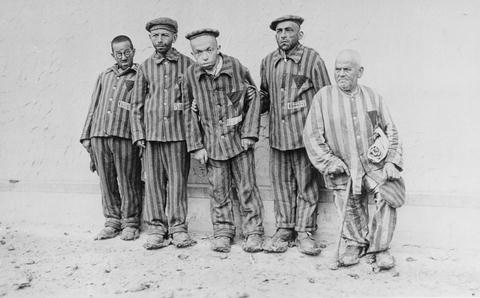


A decade later, "old enough" to handle the truth, I was informed that Cousin Benjamin had been murdered by Nazis during the Holocaust. Unacceptable as an American citizen, he was returned to Hilter. The disabled were among the first to be killed, as the most obviously undesirable kind of human (image found at A Teacher's Guide to the Holocaust). I was appalled that my own country (surely in its intellectual and moral infancy) had made such a mistake. Yet it appears that this same practice continues today in Canada.


While Benjamin's story will always stand out in my mind, denial of the human right of mobility through migration (especially but not only to escape violence) is only one of many ways disabled folks are "dumped." William J. Peace writes:


"Wheelchair dumping is the antithesis of inclusion. Disability rights activists coined the term inclusion over the well-known concept mainstreaming. For nearly two decades disabled people have fought to be included, their existence valued. This effort has met stiff resistance -- especially in the court and educational system. Disability rights activists have fought for inclusion because it reflects the idea that all members of society are equal and capable. In theory this idea is accepted but rarely if ever put into practice. It's easier and cheaper to ignore the rights of disabled people and "dump" all those who don't fit in. In the past we had institutions to dump people into -- most of which were closed in the 1980s, thanks to Ronald Reagan. In their place we have a host of inaccessible facilities, like my local police station, or other government facilities, many of which contain "resource rooms". The vast majority of these rooms accomplish what institutions once did -- segregate those that are not wanted. It is easier for institutions such as public schools to "dump" all children with learning disabilities into a "resource room" than include them in classrooms with other children. If the parent or child balks, they can deem the child disruptive and the district can literally force the child out of the district and into "special programs". It is up to the parent to hire experts and prove their child is not a disruption to other students. To me, this is the legacy that Reagan should be known for because he took dumping to an extreme -- especially for those with mental illnesses who were dumped on urban street corners across the country." (from "The Outrage is Misplaced: Wheelchair Dumping", 2008) 

We also have the questions of abortion, which I was lucky enough to escape because technology did not detect the shape of my body in utero, institutionalization, which was recommended for me on the day I was born (also narrowly escaped), and sterilization (which was unsuccessfully pushed upon me at the age of 12 in 1990). Just as Cousin Benjamin was worth more dead (valued at zero) than alive (negative value), I was reminded of my "selfishness" in keeping organs that I should never use. Never mind my love for writing, my talent with languages, my artwork; none of this could make up for the undesirability of my body, a reproductive catastrophe. Now a linguistics professor, I am reminded yet again that my mind is not enough to make me human: I should not think to try to build a life in another country. These phenomena are not of a distant past at all.


Saturday, January 9, 2010

Beauty in numbers


Lovely article in New Scientist:

'Most beautiful' math structure appears in lab for first time - physics-math - 07 January 2010 - New Scientist

Connectedness and category formation


My reflections on Teresa Brennan's Transmission of Affect have taken a (not-so-unpredictable) turn toward the linguistic. Surely I am attracted to this model of affect and humanity (interconnectedness, touching without touching) for the same reasons I find usage-based models of language much more palatable. A formal model (continuing the analogy) would posit separate human bodies, each autonomous actors, though with rules of co-occurrence, causation, etc. Nothing personal against Aristotle and his categories (image from Knowledge Representation Book), but it just doesn't feel right. Things are not this or that. Things are this and that. Sometimes what constitutes "this" and what constitutes "that" is debatable, even among the most highly informed.

OK, not only does it not feel right. The evidence suggests (convincingly) that it is not right, not in language, not in cognition. See, just to name a few, Constructing a Language: A Usage-Based Theory of Language Acquisition, Phonology and Language Use, Regularity in Semantic Change, and Usage-Based Models of Language. In these models, units are not self contained. There is the commonplace but mind-blowing evidence of priming at all levels, in semantics and syntax. There are the strikingly similar cross-linguistic paths toward abstract meanings. Everything is connected, shared and moving. 


Why would anything else in human consciousness be any different?

The ephemeral and empathy

Les gens ne disent pas des textes. Ce ne sont pas des textes. Ils parlent, tout simplement. Et vite ils oublient ce qu’ils ont dit, qui d’ailleurs ne compte pas : ils n’ont parlé que pour parler ; leurs paroles ne sont que prétextes pour parler nous-même, c’est ainsi depuis que va le monde et ce sera ainsi jusqu’à sa fin. ("Il se souvint du minium", Bernard Deglet)

I am tempted most of the time to believe this, that we are disconnected self-centered insecure beings whom mortality dooms to be pointless and whose very nature of self-as-center allows our one possible contribution beyond this life to slip into the ephemeral. Your words are just an intonation unit of waiting, and at the first hint of a chance to take my turn I will hit the floor running. Conversation as masturbation, not as intercourse. We seek out company merely for self-mirroring validation?

But no! There is something precious and painful about being near others. We are something bigger, and our empathy, ephemeral, contributes somehow. Floats out between us, within us. I have to believe that. There is evidence presented in the posthumous work of Teresa Brennan, The Transmission of Affect, that we are not self-contained in the ways that we tend to believe.

Chally, at her blog Zero at the Bone, comments that, with disability, "I no longer trust that people will stick by me when things get inconvenient, when being my friend gets messy; that I’ll get the support I need." True. But I've been lucky. There are those few who stick around through the mess and still look me in the eyes. So few, these folks, that my gratitude may seem in unfortunate disproportion to the facts. Wipe my ass for free, speak to me in soft languages, and allow me to offer some reciprocation, some comfort in return, when your life gets messy. And there I am, bursting with all of my Leo loyalty.

At the memorial service I attended yesterday, one of these few in my life was among the principal mourners. Front and center. Those who usually see only sourness in her walked single file to greet her, touch her hair, hold her in circumstantially loving embrace. I sat midway back, parked in my wheelchair, the space small and cumbersome. She came back to greet me, touched my fingertips because I moved my arm to reach for her. Gratitude and sorrow a heavy pearl in my heart. My frustration was paramount. I could not wrap my arms around her. So I locked onto her gaze. Not just waiting for my turn to start. Just waiting. Dr. Brennan believed that empathetic reactions were just as real (and reliable?) as chemical reactions: "The origin of transmitted affects is social in that these affects do not only arise within a particular person but also come from without. They come via an interaction with other people and an environment. But they have a physiological impact" (Brennan 2004:3). I hope she was right. That we can touch without touching.

Thursday, January 7, 2010

Little things

The fastest velocity is a dead stop. I learned that from Sam Beckett, maybe in "The Unnamable"? I can't remember. But there comes a point when the extreme expression of a quality becomes everything it appeared not to be. It circles around and begins/ends again.

Lately it is magnitude, in my life, that has caught my attention in its paradoxicality. My recent posts have focused on the minute: one moment recorded by a fallible frail memory, one touch of flesh (how do we measure touch, anyway?), one wary root wrapping ever more tightly around a crumbling rock-turned-sand. Of no importance to anyone, unnoticed, unnamed. Yet filling my throat and my soul and spilling out of me as text as the center of some universe I have built for myself. And this universe is not a shabby one; these nothings are everything. To me. Right now. But step back, and they are nothing again. Not visible, not seizable. Forgettable? C'est pas la peine.

"Better hope deferred than none. Up to a point. Till the heart starts to sicken. Company too up to a point. Better a sick heart than none. Till it starts to break. So speaking of himself he concludes for the time being, For the time being leave it at that." Company, Beckett

Our planet, she is magnificent:


Yet she is tiny, humble, nothing:


Nothing, and everything. Love, too, is like this, I think.

Tuesday, January 5, 2010

Uprooted


Uprooted
Originally uploaded by Jane_W
What does this feel like? How many times can roots grow?

Death and affect in the sub-tropics


One difficult thing about living in Florida--over three years now--is my sensation that the roots are missing. Instead, I find myself in a pulsating jungle, where the life and death smell hot and shocking for a Northwestern sapling gone astray. (image, right, from "History & Images of North Florida", Images, D. Penney, 2003") Lizards scurry in front of shuffling feet; armadillos lie, furry bellies exposed, shells cracked and bleeding; irises pop up out of sidewalk cracks; moss hangs orange in the setting sun. Grasshoppers as big as my hand. Owls, hawks and vultures. Spiders. Waiting for the inevitable. Nothing lasting long enough to resist the next hurricane. Uprooted, start again.

The relationships to people, too, here, feel that way. Only after these three years, do I feel roots entangled in mine, have I made connections that do not feel haphazard. (Am I talking about the fibers in Avatar? Maybe.) Yet affect has sprouted from the sandiest regions of my heart; I have better things to do than grow roots in this little landing strip! Even when we know it is all temporary, we can't help ourselves from clinging to the nearest solid bit around.

This week, my friend's young step-daughter died, circumstances unclear. Alone. Death in Florida, and one of my solid bits is crumbling beside me/within me. I hold on by growing deeper roots around the one left living. Holding off the inevitable.

Another recent death, much more distant in terms of relationships but much closer in terms of personal identification, was that of the singer-songwriter Vic Chesnutt. This week, his tune "Florida" feels particularly apt:


Suicide is not for me right now. The balance of affect and intolerability still weighs in on the side of staying around to see what happens, of not blowing away too soon, uprooting lives attached to mine.