I am a linguist who loves literature and who is fascinated by science. I quantify randomness. I paint. I travel in a power wheelchair, hoping to capture the ordinary.


Saturday, January 16, 2010

The unexpected and the brain

In an article based on a study entitled "Unsupervised statistical learning underpins computational, behavioural, and neural manifestations of musical expectation", forthcoming in Neuroimage, ScienceDaily notes:

Music has a grammar, which, like language, consists of rules that specify which notes can follow which other notes in a piece of music. According to Pearce: "the question is whether the rules are hard-wired into the auditory system or learned through experience of listening to music and recording, unconsciously, which notes tend to follow others."

The researchers asked 40 people to listen to hymn melodies (without lyrics) and state how expected or unexpected they found particular notes. They simulated a human mind listening to music with two computational models. The first model uses hard-wired rules to predict the next note in a melody. The second model learns through experience of real music which notes tend to follow others, statistically speaking, and uses this knowledge to predict the next note.

The results showed that the statistical model predicts the listeners' expectations better than the rule-based model. It also turned out that expectations were higher for musicians than for non-musicians and for familiar melodies -- which also suggests that experience has a strong effect on musical predictions.
 Read more here.

One song that makes my brain feel a little tweaked by unexpectedness is "Conversations in Silence I":

Conversations In Silence I - Nashville Chamber Orchestra

Another piece that does this by (in my amateurish opinion) using the "end" note as a "beginning" is Schumann's "5 Stücke im Volkston, Op.102: 2. Langsam" (which starts at 3:20 in the video below). This one is much subtler than the one above in its unexpectedness. But it is enough to move me repeatedly.


If the "rules" of music are not "rules" at all, but rather the consolidation of experience, the nature of language, as sister to music ("Double dissociation between rules and memory in music"), seems clear: it is an accumulation of experience, not an imperfect activation of inherent rules. Linguists Joan Bybee and James McClelland argued for an experience-based model for language in their article, "Alternatives to the combinatorial paradigm of linguistic theory based on domain general principles of human cognition."

I wonder, then, if what "moves" us in music is also what "moves" us in language. Proust wrote of the breaking of habit, the intrusion of the unexpected, as the ticket to the richest memories, a cognitive flowering of the senses. Beckett viewed language as "a veil that must be torn apart in order to get at the things (or the Nothingness) behind it," and he wrote of wanting to bore holes in the language, to create something new (or new nothingness) (see Disjecta). And in Beckett's pitted and hole-filled texts, deep within the nothingness, lies a melancholy hopeless hope. It is like trying to think of what might be outside our universe, beyond where the big bang has expanded space.

Sometimes we encode concepts like unexpectedness into our grammars. See Leonard Talmy's work on the notion of "force dynamics" in language, and an article in Cognitive Linguistics on the grammatical marking of social unexpectedness in Spanish, "Quantitative measures of subjectification."

Our (at times perverse?) pleasure in the unexpected, despite our everyday hunger for structural predictability, gives us new eyes, new ears, and yes, over the centuries, new tongues.

Friday, January 15, 2010

Earthquake 
by Aimé Césaire


such great stretches of dreamscape
such lines of all too familiar lines
                                         staved in
caved in so the filthy wake resounds with the notion
of the pair of us? What of the pair of us?
Pretty much the tale of the family surviving disaster:
“In the ancient serpent stink of our blood we got clear
of the valley; the village loosed stone lions roaring at our heels.”
Sleep, troubled sleep, the troubled waking of the heart
yours on top of mine chipped dishes stacked in the pitching sink
of noontides.
What then of words? Grinding them together to summon up the void
as night insects grind their crazed wing cases?
Caught caught caught unequivocally caught
caught caught caught
                     head over heels into the abyss
                     for no good reason
except for the sudden faint steadfastness
of our own true names, our own amazing names
that had hitherto been consigned to a realm of forgetfulness
itself quite tumbledown.

(Translated, from the French, by Paul Muldoon.)


Thursday, January 14, 2010

Bog bean : Menyanthes trifoliata

Another flower of whimsy... I hope to see it in real life one day.

Freedom, movement and pleasure


Feeling like a tree...
Originally uploaded by hajlana

Freedom means you are unobstructed in living your life as you choose. Anything less is a form of slavery. --Wayne Dyer

In the wake of the Haiti earthquake, it is hard to write about anything else. Upon seeing images of trapped bodies, dead and alive, on a small island, I can't help but think: they have no way out. So I'm thinking about movement as freedom, freedom as life, life as pleasure. Perhaps the last connection should not be made (it is generally naive). But for my purposes today, life as pleasure. (We'll leave Beckett out of this for now.)

In a recent article in French Studies, Ullrich Langer argues that the Renaissance poem offered pleasure because the poem was a landscape without constraints. All we ever want is to be able to sail away.


I am full of wanderlust, always. (I like something about the lady in this video; I find her rendition of this song touching. See lyrics.)


The trip is not always perfect, but the loneliness of human nature is less cruel when discoveries are being made.Joni Mitchell's entire album Hejira is about journeying.


To donate to help the trapped people of Haiti, here are some suggestions:

Grassroots International
Partners in Health
Haiti Emergency Relief Fund

I leave you with a 1962 video of Katherine Dunham, an American ethnologist and dancer in Haiti, who fell in love with the dances associated with Haitian vodou. After a brief interview (in French), you can see the dancing.


    retrouver ce média sur www.ina.fr

Tuesday, January 12, 2010

Little Things | FlowingData


How our age correlates with our reaction to little things... Why do I get the feeling that I'm on both sides of the curve at once?

Data Underload #4 – Little Things | FlowingData

Whimsy


I'm not one to think of myself as a softy, but I'm certainly in a whimsical mood today. What evokes the whimsical in me? That funny sweet feeling of tender other-worldliness? Here are some tastes, sounds, texts, and other elements that pull me that direction:


Prairie smoke (Geum triflorum) flowers.I have never seen them in real life, and am sure they cannot grow in Florida since they are hardy through zone 4 only, but I imagine that if fairies were to have a garden, this would surely grow there.

The smell of old homes warmed by the sun and enclosure, perfumed by the lives of women who have inhabited them for decades: layer upon layer of richness contrasted with the fresh, cool air of early spring. Proust, in his À la recherche du temps perdu (In Search of Lost Time), writes of such rooms, such smells:

C'étaient de ces chambres de province qui—de même qu'en certains pays des parties entières de l'air ou de la mer sont illuminées ou parfumées par des myriades de protozoaires que nous ne voyons pas—nous enchantent des mille odeurs qu'y dégagent les vertus, la sagesse, les habitudes, toute une vie secrète, invisible, surabondante et morale que l'atmosphère y tient en suspens; odeurs naturelles encore, certes, et couleur du temps comme celles de la campagne voisine, mais déjà casanières, humaines et renfermées gelée exquise, industrieuse et limpide de tous les fruits de l'année qui ont quitté le verger pour l'armoire; saisonnières, mais mobilières et domestiques, corrigeant le piquant de la gelée blanche par la douceur du pain chaud, oisives et ponctuelles comme une horloge de village, flâneuses et rangées, insoucieuses et prévoyantes, lingères, matinales, dévotes, heureuses d'une paix qui n'apporte qu'un surcroît d'anxiété et d'un prosaïsme qui sert de grand réservoir de poésie à celui qui les traverse sans y avoir vécu. L'air y était saturé de la fine fleur d'un silence si nourricier, si succulent, que je ne m'y avançais qu'avec une sorte de gourmandise, surtout par ces premiers matins encore froids de la semaine de Pâques où je le goûtais mieux parce que je venais seulement d'arriver à Combray: avant que j'entrasse souhaiter le bonjour à ma tante, on me faisait attendre un instant dans la première pièce où le soleil, d'hiver encore, était venu se mettre au chaud devant le feu, déjà allumé entre les deux briques et qui badigeonnait toute la chambre d'une odeur de suie, en faisait comme un de ces grands " devants de four " de campagne, ou de ces manteaux de cheminée de châteaux, sous lesquels on souhaite que se déclarent dehors la pluie, la neige même quelque catastrophe diluvienne pour ajouter au confort de la réclusion la poésie de l'hivernage; je faisais quelques pas du prie-Dieu aux fauteuils en velours frappé, toujours revêtus d'un appui-tête au crochet; et le feu cuisant comme une pâte les appétissantes odeurs dont l'air de la chambre était tout grumeleux et qu'avait déjà fait travailler et " lever " la fraîcheur humide et ensoleillée du matin, il les feuilletait, les dorait, les godait, les boursouflait, en faisant un invisible et palpable gâteau provincial, un immense "chausson" où, à peine goûtés les arômes plus croustillants, plus fins, plus réputés, mais plus secs aussi du placard, de la commode, du papier à ramages, je revenais toujours avec une convoitise inavouée m'engluer dans l'odeur médiane, poisseuse, fade, indigeste et fruitée du couvre-lit à fleurs. --Marcel Proust

He died in 1922. See this video from 1962 (in French), which discusses his unique legacy. 


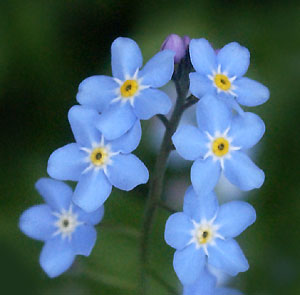
Forget-me-nots, humble little blue flowers of the north. I remember seeing them as a kid in Oregon, growing like weeds on the side of the road. They were a sweet melancholy kind of flower, small, simple, in primary colors. Yet not wanting to be forgotten. Reminding us to pay attention to the everyday fantastical.


Joni Mitchell's "Amelia" has a funny chord at the end of each verse. Joni is known for her strange chords, but this one always has moved me. When I hear it, I feel like something inside my chest is being pleasantly twisted.


Ice cream bean fruit, or Pacai, which became my most sought-after fruit after trying it in Mexico. This funny pod has large black seeds covered in what looks like fuzzy white cotton. As the name indicates, the white fuzz is creamy and sweet. So good and otherworldly! See more of Dave's images here. In Puebla they call it something else, but I can't remember the name anymore.


Spanish moss at sunset, when it glows orange or pink. This was one of the phenomena that most amazed me when I moved to Florida. I remember looking up at the trees and exclaiming, "What in the world is that?" It seemed like something out of a horror flick, but then, like something out of a dreamland.

Sunday, January 10, 2010

Memory

Your soul is a dark forest. But the trees are of a particular species, they are genealogical trees. --Marcel Proust

A part of what was lost nearly a century ago now, along with my Cousin Benjamin (see previous post), in my family's migration to the New World (new only for some, of course), was the little language of Yiddish. My grandmother (pictured on right) grew up with this language, but like nearly all first-generation US-born children, taught only English to my mother and her other children. She has told me that this loss was not an easy one: rocks were thrown at her as she walked to primary school, the funny Jewish girl with the even funnier tongue.

The origins of Yiddish are the subject of some debate,and speakers struggle to maintain the language itself.

Let me come close to the joy of the Yiddish word
Give me whole days and nights of it
Weave me, bind me into it
Feed me crumbs, with the crows
I’ll sleep on a hard bed
Under a leaky roof
Just don’t let me forget the Yiddish word
For a single Moment

-Jacob Glatstein, 1961

Click here to listen to excerpts of Yiddish read out loud. Yiddish-speakers, of course, are not the only ones fighting to maintain their language. (image above found here)

Why preserve a language that is dying? Wouldn't it be easier if we all spoke in the same way?

National Poet of Wales Gwyneth Lewis addresses this point nicely:


You can read more of her work here. Our languages, like our bodies, are richly diverse. It is only through memory that we may hope to avoid the mistakes of our ancestors, and in language and body, memory is held.